Some links in this article are affiliate links, which means we may earn a commission if you make a purchase through them, at no additional cost to you. Our recommendations are based on product ingredients, suitability, and usefulness — not the commission we may earn.
Most “best body oil” lists are really lists of finished fragrance products — a jojoba-and-vanilla blend here, a squalane-and-amber blend there — reviewed for scent and packaging rather than for what the oil itself is actually doing on your skin. That’s a different question than the one most people are asking when they search for the best body oil: which plain oil, on its own, actually suits dry skin, oily skin, sensitive skin, or skin that’s starting to show its age.
This guide covers body oil at the level of the oil itself — what determines whether one absorbs fast or sits heavy, which ones are least likely to clog pores, how long a bottle actually stays good before it oxidizes, and which specific oils the available evidence actually supports for which skin concerns. Nothing here claims a body oil detoxifies, dissolves cellulite, or permanently firms skin — claims that go beyond what any of the research below has tested.
Table of Contents
Key Takeaways
- Body oil works by occlusion — it seals water into skin rather than adding hydration itself, which is why it works best applied to already-damp skin (Harwood et al., StatPearls, 2024).
- A randomized controlled trial of 160 women found sweet almond oil reduced the itching, redness, and spread of stretch marks compared to a plain base cream — but had no measurable effect on the actual number or size of the stretch marks themselves (Hajhashemi et al., 2018).
- Avocado oil increased collagen density and wound contraction in a study on rats — a real, measured result, but an animal model, not a human clinical trial (Oliveira et al., 2013).
- Most comedogenicity ratings you see for carrier oils trace back to a single 1984 rabbit-ear assay, not a current standardized human test — useful as a rough historical guide, not a lab result on today’s product.
- Body oils have no water content, so they don’t spoil the way lotions can — but the plant oils in them still oxidize over time, and a rancid oil can irritate skin rather than help it.
What Body Oil Actually Does to Your Skin
Dermatology sorts moisturizing ingredients into three categories: humectants, which attract and bind water; emollients, which smooth the skin’s surface; and occlusives, which form a barrier that slows water evaporating out of skin (Harwood, Nassereddin, & Krishnamurthy, StatPearls, updated 2024). Plain body oil is almost entirely an occlusive. It doesn’t pull water into your skin the way a humectant like glycerin does — it seals in whatever water is already there.
That single fact explains most of the practical advice you’ll see about body oil, including the instruction to apply it to damp skin: an oil applied to bone-dry skin has little water to trap in the first place. Petrolatum, the reference-standard occlusive, reduces transepidermal water loss by close to 99% (StatPearls, 2024) — plant oils are generally considered less occlusive than petrolatum, though we did not locate a study directly comparing a specific carrier oil’s TEWL reduction against petrolatum’s figure.
For a longer look at what body oil does and doesn’t do — including why “deeply hydrating” on a label is a marketing phrase more than a mechanism — see our full guide to body oil. This article picks up from there to answer a narrower question: which specific oil fits which skin type and use case.
What Makes One Body Oil Better Than Another
Three properties do almost all the work in deciding whether a given oil suits your skin, and none of them is really about brand or scent.
Absorption speed determines how long the oil sits on the surface before it sinks in. A fast-absorbing oil like fractionated coconut or grapeseed disappears into skin within a minute or two; a slower oil like avocado or sweet almond leaves a longer window of slip and cushion, which some people want and others find heavy.
Viscosity is how thick the oil feels, and it’s a rough (not perfect) proxy for how rich it will feel on skin. A thin oil like grapeseed spreads easily over a large area like the whole body; a thick oil like avocado goes further with less product but can feel heavier in humid weather.
Comedogenicity — how likely an oil is to contribute to clogged pores — is the property most often cited with a false sense of precision. Most of the “comedogenic scale” numbers circulating online trace back to a single methodology: the rabbit-ear comedogenicity assay published by Fulton and colleagues in the Journal of the American Academy of Dermatology in 1984 (Fulton et al., 1984), an animal model whose relevance to human skin and to today’s reformulated oils is debated, not a current, standardized human clinical test.
Treat any specific “0 to 5” rating you see for a given oil as a rough historical guide, not a lab result on the bottle you’re holding.
The Best Body Oil, by Skin Type
Skin type changes which oil actually helps, not just which one feels nice on a given day. Here’s the reasoning by category.
Best Body Oil for Dry Skin
Dry skin generally benefits from a slower-absorbing, richer oil that leaves a longer window of occlusion. Sweet almond oil and avocado oil are the common recommendations here, and avocado oil has real, if preliminary, evidence behind it: in a study on Wistar rats, a semisolid avocado oil formulation increased collagen density, wound contraction, and reepithelialization compared to a petroleum jelly control (Oliveira et al., 2013).
That’s a rat wound-healing model, not a human trial on dry skin specifically — it supports avocado oil’s barrier and collagen-related activity in principle, not a specific claim about moisturizing dry human skin better than any alternative.
Best Body Oil for Oily and Combination Skin
This is the category most body oil guides skip or fold into “dry skin, but less of it.” Oily and combination skin generally does better with a lighter, faster-absorbing oil that won’t sit heavy or feel occlusive for hours. Fractionated coconut oil and grapeseed oil fit this profile: both are generally described in cosmetic-ingredient literature as light, fast-absorbing, and non-greasy relative to richer oils like avocado or sweet almond.
Best Body Oil for Sensitive Skin
Grapeseed oil is a common recommendation for sensitive skin specifically because it’s light, generally fragrance-free in its pure form, and doesn’t carry the same essential-oil-related irritation risk as scented body oil blends. If you have sensitive, reactive, or eczema-prone skin, a fragrance-free carrier oil used on its own — rather than a scented finished body-oil product — removes one of the more common sources of irritation before you’ve even considered which base oil to use.
Best Body Oil for Mature and Crepey Skin
Argan oil is the most commonly recommended option here, generally described as carrying meaningful vitamin E content alongside its fatty acid profile. That’s a composition-based rationale — vitamin E is a recognized antioxidant — not a claim that argan oil measurably firms or tightens skin; we did not locate a controlled human trial testing argan oil specifically against crepey or aging body skin.
Best Body Oil for Acne-Prone Skin (Back, Chest, Shoulders)
Rosehip oil is the most frequently recommended option for body acne, and the reasoning traces back to a specific, older finding: Downing, Stewart, Wertz, and Strauss, in a 1986 paper in the Journal of the American Academy of Dermatology, reported reduced linoleic acid in the surface lipids of acne-affected skin relative to unaffected skin, and proposed that this relative insufficiency contributes to comedone formation (Downing et al., 1986).
That’s a finding about the skin’s own sebum chemistry, not a clinical trial of rosehip oil applied to acne-prone skin — but it’s the reasoning most commonly cited for why oils higher in linoleic acid, like rosehip and grapeseed, are recommended over heavily oleic oils for breakout-prone skin.
Body Oil Comparison Table
A caveat before this table, the same one that applies to any comedogenicity figure online: the “Generally rated” column reflects a common description repeated across cosmetic-chemistry sources, most tracing back to the 1984 rabbit-ear assay discussed above, not a precise clinical measurement on a specific product.
Oil Best fit Absorption Viscosity Fatty acid profile Generally rated Jojoba oil All-purpose, combination Moderate Moderate, consistent Liquid wax ester; sebum-like Low-to-moderate comedogenicity, sources vary Fractionated coconut oil Oily, combination Fast Light Saturated (caprylic/capric) Generally rated low Grapeseed oil Sensitive, oily, acne-prone Fast Light High in linoleic acid Generally rated low Sweet almond oil Dry skin Moderate-slow Rich Higher in oleic acid Reports vary, low-to-moderate Argan oil Mature, crepey skin Moderate-slow Moderate-rich Balanced oleic/linoleic, vitamin E Reports vary, low-to-moderate Avocado oil Very dry skin Slow Rich High in oleic acid Reports vary, moderate Rosehip seed oil Acne-prone skin Fast-moderate Light-moderate High in linoleic acid Generally rated low-to-moderate Shelf Life and Oxidation: When a Body Oil Goes Bad
Because body oil has no water content, it doesn’t spoil the way a water-based lotion can — there’s no water for mold or bacteria to grow in. That’s a real advantage, and it’s the reason body oil guides commonly describe oils as shelf-stable.
But “no water” doesn’t mean “doesn’t degrade.” Plant oils undergo a separate chemical process called autoxidation, a radical chain reaction in which unstable compounds called lipid hydroperoxides form and break down further into the aldehydes, ketones, and free fatty acids responsible for a rancid smell (research on refined vegetable oil storage, Molecules, 2022).
That research examined food-grade vegetable oils under market storage conditions, not cosmetic body oils specifically, but the underlying chemistry — unsaturated fatty acids reacting with oxygen over time — is the same process at work in a bottle of carrier oil on your bathroom shelf.
In practice: oils higher in polyunsaturated fatty acids (like grapeseed and rosehip) oxidize faster than oils higher in monounsaturated or saturated fat (like olive or fractionated coconut). Store any body oil away from direct light and heat, keep the cap on tightly, and treat a change in smell — a sharp, crayon-like, or “off” note replacing the oil’s normal scent — as the practical sign to stop using it, rather than relying on a printed expiration date alone.
Face Oil vs. Body Oil: Can You Use One for the Other?
Mostly, yes, with one practical caveat. Face skin is thinner and generally more prone to clogged pores than body skin, so a face oil chosen for its low comedogenicity — like squalane or rosehip, discussed in our guide to face oil for gua sha — will also work fine on the body. The reverse isn’t always true: some body oils marketed for their rich, cushioning feel on arms and legs, like heavier avocado or sweet almond formulations, can feel too heavy or occlusive on facial skin, particularly for anyone acne-prone.
If you’re mixing your own oils for skin versus a specific application like diluting essential oils, the reasoning is the same across both use cases: it comes down to the base oil’s absorption speed, viscosity, and comedogenicity, not whether the bottle is labeled “face” or “body.” Our guide to choosing a carrier oil covers that selection process in more depth if you’re blending your own.
How Much Body Oil to Use, and How to Apply It
There isn’t a single clinically studied “correct” amount of body oil — most guidance here is practitioner-sourced rather than research-derived. A commonly cited starting point is two to three pumps or roughly a quarter-sized amount for the whole body, adjusted up for a richer, slower-absorbing oil covering more skin, or down for a lighter oil.
- Apply right after a shower or bath, while skin is still damp, not fully dry — this is the single most consistent piece of advice across both the clinical literature on occlusives and every body oil guide we reviewed, since the oil has more water to actually seal in.
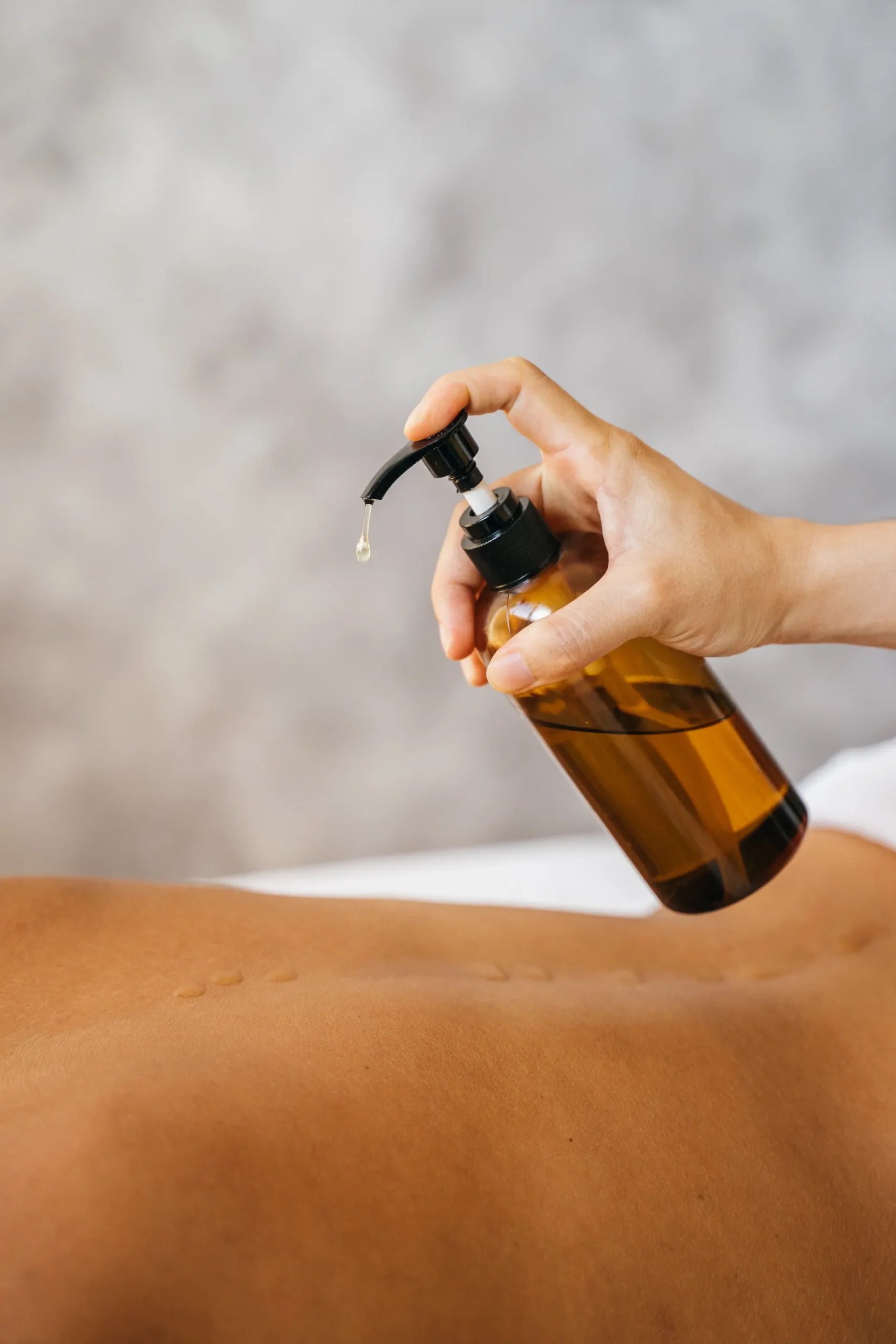
- Warm the oil between your palms first, then smooth it on in the direction of hair growth rather than rubbing it in circles, which helps it spread evenly without pulling at skin.
- If you towel-dry before applying oil, pat rather than rub, and leave skin slightly damp rather than bone-dry.
- Give the oil a minute to absorb before dressing, especially with a richer, slower oil like avocado or sweet almond, to avoid transferring oil onto clothing.
- If you also use a body lotion, apply the lotion first for its water content, then seal it in with oil — not the other way around.
Mistakes to Avoid With Body Oil
- Applying it to completely dry skin and expecting hydration. An occlusive oil on dry skin with nothing to seal in will just sit on the surface rather than doing its job.
- Treating a heavily scented, finished body-oil product as equivalent to a plain carrier oil. Added fragrance and essential oils are a well-documented source of contact irritation that a plain, fragrance-free oil doesn’t carry.
- Ignoring a change in smell. An oxidized, rancid oil can irritate skin rather than help it — smell is a more reliable day-to-day signal than a printed expiration date.
- Using a rich, slow-absorbing oil on acne-prone skin because it “feels more moisturizing.” Feel isn’t the same as comedogenicity — a lighter, linoleic-acid-rich oil is the better-reasoned choice for breakout-prone areas even if it feels less luxurious.
- Expecting a body oil to firm, tighten, or “detox” skin. No oil discussed in this guide has controlled human evidence supporting those specific claims; the real, evidence-backed benefits are occlusion, barrier support, and in avocado oil’s case, a preliminary animal-model signal for collagen and wound healing.
Best Body Oils: Product Picks by Skin Type
A short, cross-brand list of plain carrier oils — not a full store shelf, and not a single scented finished-product review. Every product below is US-available and single-ingredient; names and sizes were checked against the brand’s own product page at the time of writing. Prices are described in relative terms rather than fixed numbers, since exact current pricing couldn’t be confirmed as current — check the linked page for today’s price.
Best for dry skin — NOW Solutions Sweet Almond Oil. Single ingredient (Prunus Amygdalus Dulcis Oil), unscented, sold in 4 oz and 16 oz sizes at drugstores and online retailers.
Best for very dry or mature skin — NOW Solutions Avocado Oil. Single ingredient (Persea Gratissima Oil), 100% pure, sold in 4 oz and 16 oz sizes.
Best for oily and combination skin — NOW Solutions Liquid Coconut Oil, Pure Fractionated. Colorless, odorless, light-textured, sold in 4 oz and 16 oz sizes.
Best for sensitive skin — NOW Solutions Grapeseed Oil. Single ingredient (Vitis Vinifera Seed Oil), light and unscented, marketed specifically for sensitive skin.
Best for mature and crepey skin — Josie Maran 100% Pure Argan Oil. Single ingredient (Argania Spinosa Kernel Oil), sold in a 1.7 fl oz standard size with a smaller travel size available.
Best for acne-prone skin — The Ordinary 100% Organic Cold-Pressed Rose Hip Seed Oil. Single ingredient (Rosa Canina Seed Oil), sold in a 30 mL bottle.
None of the products above are claimed here to firm, tighten, detoxify, or permanently change skin — the reasoning for each pick is absorption speed, comedogenicity, and fatty acid profile relative to the skin-type guidance above, not a promise about outcomes no study has tested.
Frequently Asked Questions
What’s the healthiest oil for your skin?
There isn’t one single “healthiest” oil for everyone — it depends on your skin type. Lighter, linoleic-acid-rich oils like grapeseed and rosehip are the more evidence-grounded choice for oily or acne-prone skin, while richer, oleic-acid-rich oils like avocado and sweet almond suit dry skin better. “Healthiest” is really a fit question, not a ranking.
Which body oil is best for skin?
Across skin types, jojoba oil is the most commonly recommended all-purpose default, since its composition as a liquid wax ester is generally described as close to human sebum, putting it in the middle on both absorption speed and comedogenicity. For a specific concern — dryness, oiliness, sensitivity, or acne — see the by-skin-type breakdown above.
What is the best oil for moisturizing the body?
Technically, body oil moisturizes by sealing water in rather than adding water itself, so the “best” oil for this purpose is whichever one you’ll actually apply to damp skin right after a shower — the application timing matters more than the specific oil. Among the options, richer oils like avocado and sweet almond hold that seal longer than lighter oils like grapeseed or fractionated coconut.
Which oil is best for skin aging?
Argan oil is the most commonly recommended option for mature skin, on the strength of its fatty acid and vitamin E content, though we did not locate a controlled human trial testing argan oil specifically against aging body skin. Avocado oil has a preliminary evidence signal for collagen density and wound healing, but from a study on rats, not people — worth knowing if you’re looking for the strength of the underlying evidence rather than just the ingredient reputation.
What body oil is best for mature skin over 60?
The same reasoning as general mature skin applies — argan or avocado oil for their richer, slower-absorbing profile — with one added consideration: skin tends to get measurably thinner and drier with age, so a richer oil applied to damp skin, potentially layered under a lotion, is more likely to be needed than a light, fast-absorbing option.
Does body oil actually hydrate skin, or just moisturize it?
Moisturize, not hydrate, in the strict dermatological sense — body oil is an occlusive, not a humectant, so it seals in water rather than adding it. See our guide to what body oil actually does for the full explanation of that distinction.
Is body oil safe to use during pregnancy?
Plain carrier oils like the ones in this guide are generally considered lower-risk than scented, essential-oil-blended body oils during pregnancy, and sweet almond oil specifically has been studied in this context: a randomized trial of 160 women found it reduced the itching, redness, and spread of stretch marks compared to a plain base cream, though it had no measurable effect on the actual number or size of the stretch marks (Hajhashemi et al., 2018).
This article is not medical advice — bring your specific product to your OB-GYN before adding it to your routine.
The Bottom Line on the Best Body Oil for Your Skin Type
The best body oil for your body is mechanical, not magical: an oil that matches your skin’s absorption and comedogenicity needs, applied to damp skin so it actually has water to seal in. Lighter oils like grapeseed and fractionated coconut for oily, combination, and sensitive skin; richer oils like avocado and sweet almond for dry and mature skin; jojoba as the moderate, all-purpose default; and linoleic-acid-rich oils like rosehip for acne-prone skin.
The evidence behind specific claims varies a lot by oil and claim. Sweet almond oil’s stretch-mark benefit is real but narrower than marketing suggests — it helps itching and redness, not the marks themselves, per a 160-person randomized trial. Avocado oil’s collagen and wound-healing signal is genuinely interesting but comes from a study on rats, not people. None of that is a reason to skip body oil — it’s a reason to pick one for what it’s actually been shown to do.
About the Author
Written and researched by the BodyOilGuide.com editorial team. Read our editorial policy for how we research, source, and fact-check skin-care content.
Sources
- Harwood, A., Nassereddin, A., & Krishnamurthy, K. “Moisturizers.” StatPearls [Internet], National Center for Biotechnology Information, updated February 12, 2024. ncbi.nlm.nih.gov/books/NBK545171/
- Hajhashemi, M., et al. “The effect of Aloe vera gel and sweet almond oil on striae gravidarum in nulliparous women.” Journal of Maternal-Fetal & Neonatal Medicine, 2018. Double-blind RCT, 160 nulliparous women. pubmed.ncbi.nlm.nih.gov/28521546/
- Oliveira, A.P. de, et al. “Effect of Semisolid Formulation of Persea Americana Mill (Avocado) Oil on Wound Healing in Rats.” Evidence-Based Complementary and Alternative Medicine, 2013;2013:472382. An animal model (Wistar rats), not a human clinical trial. pmc.ncbi.nlm.nih.gov/articles/PMC3614059/
- Fulton, J.E., Pay, S.R., & Fulton, J.E. “Comedogenicity of current therapeutic products, cosmetics, and ingredients in the rabbit ear.” Journal of the American Academy of Dermatology, January 1984. The rabbit-ear assay that underlies most comedogenicity ratings still circulated online today.
- Downing, D.T., Stewart, M.E., Wertz, P.W., & Strauss, J.S. “Essential fatty acids and acne.” Journal of the American Academy of Dermatology, 1986. A mechanistic/compositional finding about linoleic acid levels in acne-affected skin, not a clinical trial of any specific carrier oil.
- “Monitoring the Shelf Life of Refined Vegetable Oils under Market Storage Conditions — A Kinetic Chemofoodmetric Approach.” Molecules, 2022;27(19):6508. Research on food-grade vegetable oil storage; cited here for the general chemistry of lipid autoxidation, not a claim specific to cosmetic body oils. doi.org/10.3390/molecules27196508
- Product names, ingredients, and sizes for the picks above were checked against each brand’s own product page (nowfoods.com, josiemaran.com, theordinary.com) at the time of writing. Prices are intentionally not stated as fixed figures, since current pricing could not be confirmed as current at the time of writing.