Some links in this article are affiliate links, which means we may earn a commission if you make a purchase through them, at no additional cost to you. Our recommendations are based on product ingredients, suitability, and usefulness — not the commission we may earn.
Most gua sha guides tell you which oil to buy and skip the two questions that actually matter: what is the oil supposed to be doing while a stone drags across your skin, and does gua sha itself do what the marketing says?
The best face oil for gua sha changes how the tool glides, how much your skin tugs, and whether you’re layering fragrance risk onto skin that’s already being mechanically stressed. This guide covers oil selection by skin type with the reasoning behind each pick, what one real 2025 clinical trial measured (and didn’t), and a technique section that doesn’t skip the parts that actually cause irritation. If you searched for a face oil for lymphatic drainage specifically, the short answer is the same: the oil provides slip for the massage, not the drainage itself, and this guide covers exactly where that distinction matters.
Table of Contents
Key Takeaways
- One recent randomized controlled trial (Ahn et al., Journal of Cosmetic Dermatology, 2025) measured facial contour and muscle-tone changes from gua sha over 8 weeks — but in the same trial, a facial roller, not gua sha, was the one that significantly improved skin elasticity. Gua sha showed no significant elasticity change.
- That trial did not measure lymphatic drainage, fat loss, or permanent results. Claims about “sculpting fat away” or “guaranteed lymphatic drainage” go beyond what this or any controlled study we could locate has tested.
- Slip matters more than any specific ingredient: a face oil for gua sha that absorbs too fast causes dragging, which practitioners report as a contributor to gua sha–related redness and, with firmer pressure, temporary bruising.
- Oily skin is one of the most-skipped categories across current gua sha oil guides — most either omit it or fold it into “combination” without a real recommendation.
- Essential oils and added fragrance are a documented irritation risk in the broader contact-dermatitis literature — lavender’s key allergen, linalool, becomes measurably more allergenic once it oxidizes in air (Sköld et al., Contact Dermatitis, 2002; 2008).
- Published comedogenicity ratings for carrier oils vary between sources because most trace back to a single 1984 rabbit-ear assay methodology (Fulton et al., J Am Acad Dermatol, 1984), not a current, standardized human test. Treat any “0 to 5” number you see online as a rough historical guide, not a lab result on today’s product.
Does Gua Sha Have Real Evidence, and What Does That Have to Do With the Oil?
Gua sha’s evidence base for facial use is thinner than the volume of content about it would suggest, but it isn’t nonexistent, and it’s worth being precise about what has and hasn’t been tested — the same distinction this site draws elsewhere between a plausible mechanism and a proven one.
One recent randomized controlled trial, by Ahn and colleagues, published in the Journal of Cosmetic Dermatology in May 2025, compared facial roller massage against gua sha massage in 33 women aged 20 to 50 (17 in the gua sha group, 16 in the roller group, one dropout).
Participants used their assigned tool for 10 minutes, five times a week, for eight weeks — a considerably more consistent routine than the “two or three times a week” most gua sha content casually recommends. Gua sha has also been studied in other, non-facial contexts, such as musculoskeletal and fascia research; this trial is the one specific to facial skin and appearance outcomes, not the only gua sha study to exist.
The results are genuinely interesting, and not entirely what gua sha marketing implies. According to the trial, the gua sha group showed statistically significant reductions in facial surface distances of 2.23 to 2.40 mm (p<0.001), which the researchers read as a modest contouring effect, along with reduced muscle oscillation frequency and dynamic stiffness — signs the authors interpreted as facial muscle relaxation.
On skin elasticity, however, the facial roller group improved significantly (gross elasticity up 8.6%, biological elasticity up 7.5%, both p<0.001), while the gua sha group showed no significant elasticity change — a between-group difference the study also reported as statistically significant.
The trial’s own authors reported real limitations: 33 healthy adult women in one age band, no standardized clinical photography, no follow-up past eight weeks, and no arm testing gua sha and rolling combined (Ahn et al., 2025). Nothing in this study, or in the broader literature we could locate, measured lymphatic fluid movement, fat reduction, or a permanent lift. If you’ve seen those specific claims attached to gua sha marketing, they go beyond what this controlled trial — or any we could find — has actually tested.
That doesn’t mean gua sha does nothing; the muscle-relaxation and contour findings above are real, measured, and statistically significant in this one trial. It means the more accurate summary is: for muscle tension and short-term contour, there is now one real randomized trial showing a measured effect; for lymphatic drainage, detoxification, or a permanent sculpting result, we found no controlled evidence either way.
None of that trial measured the face oil for gua sha itself. The oil’s job in that protocol, and in every gua sha routine, is mechanical: giving the tool enough slip to do whatever gua sha does without also dragging at the skin doing it.
What the Oil Is Actually Doing: Slip, Absorption, and Viscosity
Three properties determine how well a face oil for gua sha performs, and none of them is “what’s in it”:
Slip (glide) is how easily the stone moves across skin without catching. Practitioners commonly describe insufficient slip as a cause of tugging, which is uncomfortable and, anecdotally, is associated with the same kind of minor redness — or, with firmer pressure, visible petechiae (small red or purple spots) — that a Kiehl’s-consulted aesthetician described in an interview about gua sha technique, noting it “usually disappears within one to five days.”
That’s a practitioner’s clinical observation shared in an editorial interview, not a peer-reviewed statistic, and it’s worth reading it that way: plausible and commonly reported, not independently quantified in a trial we could locate.
Absorption speed determines how long that slip lasts. A face oil for gua sha that sinks in within a minute or two leaves you dry-dragging partway through a session; you’ll either need to reapply or choose something that sits on the surface longer.
Viscosity — how thick a face oil for gua sha feels — determines how much cushion it gives the stone. A thin oil like squalane transmits pressure more directly; a thicker oil like sweet almond or argan cushions the stroke, which may matter more with firmer pressure or on thinner, more reactive skin. This is a textural/mechanical description based on general cosmetic-oil characteristics rather than a claim backed by a specific gua sha study.
Best Face Oil for Gua Sha, by Skin Type
Skin type changes which oil actually helps, not just which one feels nice. Here’s the reasoning by category, not just a list.
Best Face Oil for Gua Sha for Dry Skin
Dry skin generally benefits from a face oil for gua sha with more cushion and a slower absorption rate, so it doesn’t dry-drag halfway through the massage. Argan oil and sweet almond oil are commonly recommended here: both are generally described as higher in oleic acid than lighter oils like rosehip, which tends to correlate with a richer feel and slower absorption. That’s the same richness that can be a liability on oilier or more breakout-prone skin, so it’s a fit-for-purpose recommendation, not a universal “better” oil.
Best Face Oil for Gua Sha for Oily Skin
This is the category most gua sha oil guides skip entirely or fold vaguely into “combination.” Oily skin generally does better with a lighter, faster-absorbing oil that still provides enough slip for the full stroke.
Squalane for gua sha is a common recommendation for this reason — it’s generally described in cosmetic-ingredient literature as light and fast-absorbing relative to richer plant oils. Hemp seed oil is another frequently suggested lightweight option. If dragging becomes an issue partway through a session, that’s a cue to reapply a drop rather than switch to a heavier oil that may feel more occlusive than oily skin wants.
Best Face Oil for Gua Sha for Combination Skin
Combination skin is the case for a moderate-viscosity oil rather than one at either extreme. Jojoba oil for gua sha is a common default: jojoba is technically a liquid wax ester rather than a triglyceride oil, which is part of why its composition is often described as close to human sebum, and it’s generally reported to sit in the middle on both absorption speed and glide — workable across drier and oilier zones of the same face without needing to switch products mid-routine.
Best Face Oil for Gua Sha for Sensitive and Acne-Prone Skin
This is where ingredient choice matters most, and where the fatty-acid research actually applies. Downing, Stewart, Wertz, and Strauss, in a foundational 1986 paper in the Journal of the American Academy of Dermatology, reported reduced linoleic acid in the surface lipids of acne-affected skin relative to unaffected skin, and proposed that this relative insufficiency contributes to comedone formation (Downing et al., 1986).
That’s a finding about the skin’s own sebum chemistry, not a clinical trial of any specific carrier oil applied topically for gua sha — but it’s the finding most commonly cited as the reasoning behind why oils higher in linoleic acid, like rosehip oil for gua sha, are more often recommended for acne-prone skin than oils that lean heavily oleic.
Squalane is the other frequently recommended option here on the strength of its light texture, though “generally well tolerated” reflects a broad pattern across skincare use, not a specific clinical claim about gua sha itself.
Fragrance matters at least as much as the base oil here. See the irritation section below before reaching for anything scented on sensitive or reactive skin.
Best Face Oil for Gua Sha for Mature Skin
Mature skin tends to run drier and can generally tolerate — and may prefer — a richer oil with more glide time. Argan oil and sweet almond oil fit this profile for the same viscosity-and-absorption reasoning as dry skin, often paired with a preference for oils that also carry natural antioxidant content such as vitamin E. That’s a texture-and-composition rationale, not a claim that either oil measurably firms, lifts, or permanently improves skin — we found no evidence supporting that specific claim for either ingredient.
Comedogenicity and Fragrance Risk: A Comparison Table
A genuine caveat before this table: online “comedogenic scale” numbers for carrier oils vary meaningfully between sources — we checked several and found jojoba oil rated anywhere from 0 to 2 depending on the site.
Most of these ratings trace back to a single methodology: the rabbit-ear comedogenicity assay published by Fulton and colleagues in the Journal of the American Academy of Dermatology in 1984 (Fulton et al., 1984), an animal model whose relevance to human skin and to today’s reformulated products is debated, not a current, standardized human clinical test. Treat the “Generally rated” column below as a common description repeated across cosmetic-chemistry sources, not a precise clinical measurement.
| Oil | Best fit | Slip / glide | Absorption speed | Fatty acid profile | Generally rated | Natural scent / added fragrance |
|---|---|---|---|---|---|---|
| Jojoba oil | Combination, all-purpose | Moderate, consistent | Moderate | Liquid wax ester; sebum-like composition | Low-to-moderate comedogenicity, sources vary | Essentially odorless in pure form |
| Squalane | Oily, sensitive, acne-prone | Light | Fast | Saturated hydrocarbon (hydrogenated squalene) | Generally rated low | Odorless |
| Rosehip seed oil | Sensitive, acne-prone | Light-moderate | Fast-moderate | High in linoleic acid | Generally rated low-to-moderate | Mild natural (earthy/nutty), not an added fragrance |
| Argan oil | Dry, mature | Moderate-rich | Moderate-slow | Balanced oleic/linoleic | Reports vary, low-to-moderate | Mild natural (nutty) |
| Hemp seed oil | Oily, acne-prone | Light | Fast | High in linoleic acid | Generally rated low | Mild natural (grassy) |
| Sweet almond oil | Dry, mature | Rich | Slow | Higher in oleic acid | Reports vary, low-to-moderate | Mild natural (nutty) — tree-nut derived; avoid with nut allergies |
The last column is doing real work: a “natural scent” from the face oil for gua sha itself is a different, generally lower-risk thing than added fragrance or essential oils blended into a finished product. That distinction is where the next section matters.
Fragrance and Essential Oil Irritation — the Part Most Guides Skip
Essential oils are a well-documented cause of allergic contact dermatitis in the dermatology literature, and lavender oil is a useful, well-studied example. Lavender’s two dominant components, linalool and linalyl acetate, are recognized fragrance allergens, and research from Sköld and colleagues found that linalool becomes measurably more allergenic once it autoxidizes on exposure to air, identifying specific linalool hydroperoxides formed during that process (Sköld et al., Contact Dermatitis, 2002).
A follow-up study from the same research group found that linalyl acetate undergoes a similar autoxidation process, also forming potent contact allergens (Sköld et al., Contact Dermatitis, 2008); separate research has since found air-oxidized linalool to be a frequent cause of fragrance contact allergy in patch-tested dermatitis patients (Bråred Christensson et al., Contact Dermatitis, 2012). Practically, this means an older or improperly sealed lavender-containing product carries more allergy risk than a fresh one.
This matters more in a gua sha context than in an ordinary leave-on moisturizer, because the scraping motion is already mechanically stressing the skin; adding a fragrance allergen on top of that isn’t the moment to experiment with a new scented oil.
Practical takeaways:
- If you have sensitive, reactive, rosacea-prone, or eczema-prone skin, consider a fragrance-free and essential-oil-free oil for gua sha specifically, even if you tolerate scented products elsewhere.
- A “natural scent” from the base oil itself (rosehip’s earthy note, argan’s nutty one) is not the same category of documented allergy risk as an added essential oil blended in for fragrance.
- Patch-test any new oil on your inner forearm 24 to 48 hours before using it on your face, especially anything marketed with essential oils added.
- If you notice redness that doesn’t fade within roughly an hour of a session, or any itching, stop and switch to an unscented option before your next session. Persistent or worsening reactions are worth a dermatologist’s opinion rather than continued self-treatment.
How Much Face Oil to Use for Gua Sha
There isn’t a single clinically studied “correct” amount of face oil for gua sha. In an interview about gua sha technique published by Kiehl’s, aesthetician Natalie Aguilar recommended starting with 2 to 3 drops and adding more if the tool starts to drag.
That’s a working, practitioner-sourced starting point rather than a research-derived dose, and it’s reasonable to adjust it for your face size and the viscosity of your face oil for gua sha — a lighter, faster-absorbing oil like squalane may need reapplying sooner, while a richer oil like argan or sweet almond tends to go further. Apply to clean, slightly damp skin before you pick up the tool, and treat “does the stone glide without catching” as the real signal, not a fixed drop count.
How to Actually Use Gua Sha With Oil
- Cleanse first. Oil applied over makeup, sunscreen, or the day’s buildup won’t glide as evenly. If cleansing oils are part of your routine already, see our guide to the oil cleansing method for how that step works.
- Apply your face oil for gua sha to slightly damp skin, starting with roughly 2 to 3 drops and adding more as needed.
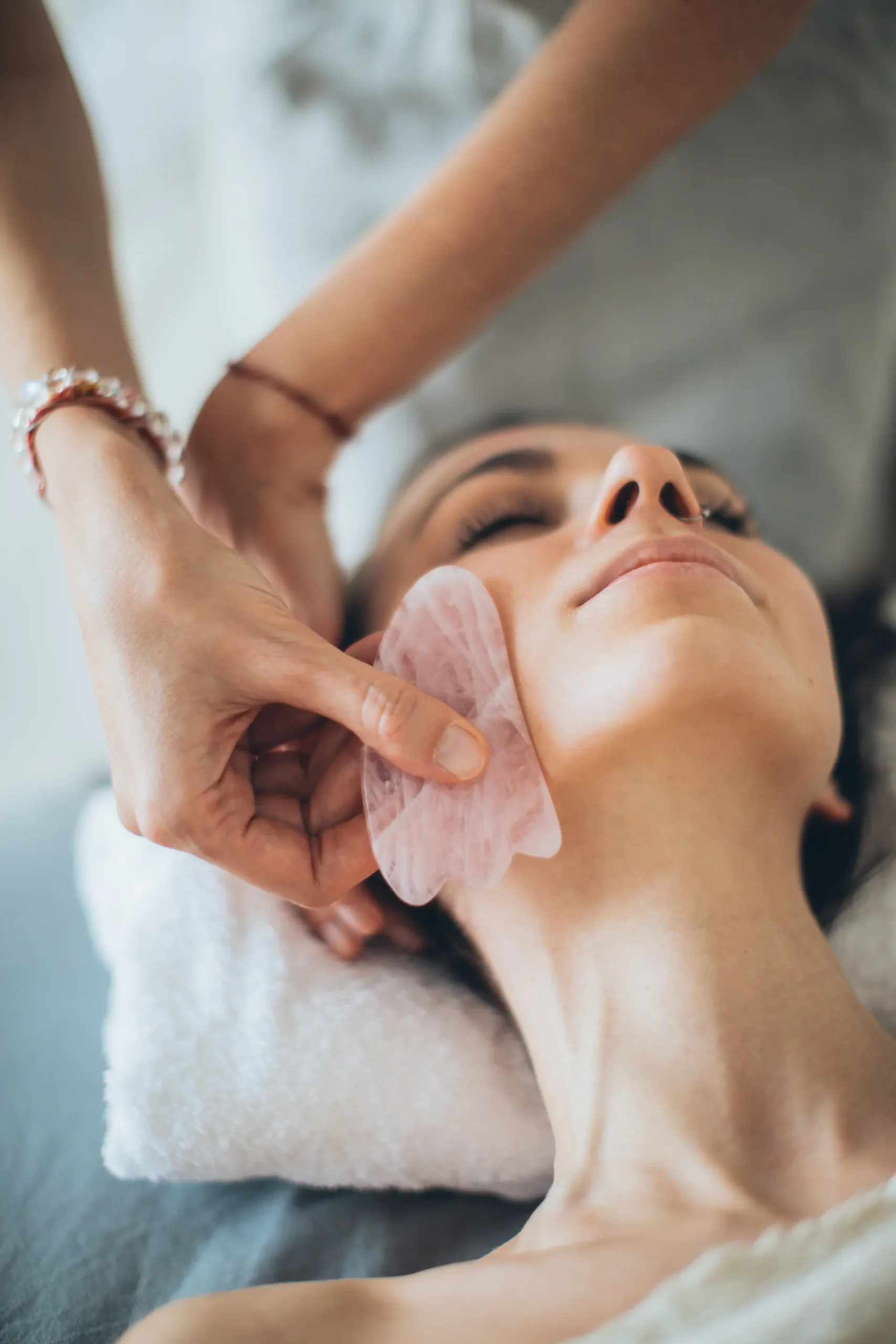
- Start at the center of your face and work outward and upward — along the jaw toward the ears, up the cheeks toward the hairline. This direction is consistent across most gua sha instruction, generally described as following the direction lymph moves toward the neck, though we did not locate controlled research specifically measuring lymphatic outcomes from this stroke pattern.
- Use light to medium pressure in long, even strokes. Firmer pressure has been anecdotally and practitioner-reported to increase visible petechiae and temporary bruising; if that’s not a look you want, ease off rather than push through resistance.
- Reapply oil the moment you feel dragging. This matters more than hitting an exact drop count.
- Avoid the delicate eye area until you’re comfortable with pressure control elsewhere on your face.
- Skip gua sha on sunburned, actively broken-out, or freshly exfoliated/retinoid-treated skin, where the skin barrier is already compromised and mechanical stress is more likely to irritate it.
- Clean your tool with warm water after each use and store it dry — oil residue left on stone or metal tools can go rancid or harbor bacteria between uses.
For reference, the RCT covered above used 10-minute sessions, five days a week, for eight weeks — a meaningfully more consistent routine than most casual advice suggests, and worth knowing if you’re trying to approximate what was actually measured rather than just “using gua sha sometimes.”
Best Face Oils for Gua Sha: Product Picks by Skin Type
A short, cross-brand list of face oil for gua sha options — not a full store shelf. Every product below is US-available and single-ingredient unless noted otherwise; names, ingredients, and sizes were checked against the brand’s own product page or a major US retailer. Prices are described in relative terms rather than fixed numbers, since exact current pricing couldn’t be confirmed as current at the time of writing — check the brand’s or retailer’s own page for today’s price.
Best overall — NOW Solutions 100% Pure Jojoba Oil. Single ingredient (Simmondsia Chinensis Seed Oil), sold in 1 oz, 4 oz, and 16 oz sizes, with larger sizes offering a lower per-ounce cost. A straightforward, moderate-viscosity option that fits the combination-skin reasoning above and is widely available at US drugstores and online retailers.
Best for oily skin — The Ordinary 100% Plant-Derived Squalane. A single-ingredient, sugarcane-derived squalane in a 30 mL (1.01 fl oz) bottle. One of the lower-priced options in this list, fragrance-free, and its light texture fits the oily-skin reasoning above.
Best for dry skin — Josie Maran 100% Pure Argan Oil. Single ingredient (Argania Spinosa Kernel Oil), sold in a 1.7 fl oz (50 mL) standard size, with a smaller travel size available at a lower price point. The brand lists it as free of synthetic fragrance.
Best for sensitive skin — Biossance 100% Squalane Oil. A single-ingredient, sugarcane-derived squalane in a 3.4 fl oz (100 mL) bottle, sold at Sephora and directly through Biossance. No added fragrance; squalane’s light, generally well-tolerated texture is why it appears twice in this list, from two different brands, for two different skin concerns.
Best for acne-prone skin — The Ordinary 100% Organic Cold-Pressed Rose Hip Seed Oil. Single ingredient (Rosa Canina Seed Oil), sold in a 30 mL (1.01 fl oz) bottle at Sephora, Ulta, and theordinary.com. One of the more affordable options here, and its naturally higher linoleic-acid content is the specific reasoning covered in the sensitive/acne-prone section above. It carries a mild natural scent from the oil itself, not an added fragrance.
Best budget option — Good Molecules Pure Cold-Pressed Rosehip Seed Oil. Also a single-ingredient rosehip seed oil (Rosa Rubiginosa Seed Oil), sold at Ulta and directly through Good Molecules in a small 0.44 fl oz (13 mL) bottle — the smallest, lowest-cost format in this list, useful for trying the ingredient before committing to a larger bottle like the pick above.
None of the products above are claimed here to lift, sculpt, detoxify, cure acne, or permanently change skin — the reasoning for each pick is texture, absorption speed, and ingredient profile relative to the skin-type guidance above, not a promise about outcomes no study has tested.
If you’re also curious how a heavier, less conventional single-ingredient oil performs on facial skin specifically, our castor oil for face guide covers a different use case than gua sha’s slip requirement — castor oil’s thick, tacky texture makes it a poor fit for gua sha glide specifically, even where it has other facial uses.
Frequently Asked Questions
What face oils should I use with gua sha?
It depends primarily on your skin type rather than one universal answer: lighter, faster-absorbing oils like squalane or hemp seed oil for oily or acne-prone skin; richer, slower oils like argan or sweet almond for dry or mature skin; jojoba oil as a moderate, all-purpose middle ground. Across all types, fragrance-free options carry less documented irritation risk than scented ones.
What should I put on my face before gua sha?
Start with a clean face — cleanse and, if it’s part of your routine, tone first. Apply your chosen face oil to slightly damp skin immediately before using the tool; oil provides the slip the stone needs, and applying it to dry, unprepped skin increases dragging.
Should I use gua sha with oil, or is a serum enough?
A face oil for gua sha is the more commonly recommended choice specifically for slip. Water-based serums tend to absorb faster and provide less sustained glide, which can increase tugging partway through a session. Some routines layer a hydrating serum first and a face oil for gua sha on top; if you do that, give the serum a minute to absorb before adding oil so you’re not diluting the glide of your face oil for gua sha.
Does Face Oil Help With Lymphatic Drainage?
“Face oil for lymphatic drainage” is a common way people search for this topic, but it is worth being precise about what the oil is and is not doing. Its role is the same one covered throughout this guide: providing slip so a gua sha tool or your hands can glide smoothly, following the direction lymph generally moves toward the neck. The oil itself is not the mechanism that moves lymphatic fluid, and, as covered above, no controlled study we could locate has actually measured lymphatic drainage from a gua sha or facial-massage routine. If lymphatic drainage specifically is your goal, the massage technique and direction matter more than which oil you use, and a good slip oil just lets you perform that technique comfortably.
Is it safe to use face oil for gua sha during pregnancy?
General pregnancy-skincare guidance from dermatologists and estheticians tends to focus caution specifically on essential oils and certain active ingredients — some, including rosemary, clary sage, and tea tree, are more commonly flagged than others — rather than on plain carrier oils. We did not find a specific clinical safety ranking of individual carrier oils like jojoba, squalane, or rosehip in pregnancy, so we’re not in a position to call any of them “lower-risk” here.
This article is not medical advice: if you’re pregnant, the safest approach is to bring your specific product and ingredient list to your OB-GYN or dermatologist before adding it to your routine, since individual medical history matters more than general guidance can account for.
What’s the best face oil for gua sha if I have oily skin?
Squalane or hemp seed oil are the more commonly recommended options — both are generally described as lighter and faster-absorbing than richer oils like argan or almond, so they’re less likely to feel heavy on oilier skin while still providing enough slip for the massage.
What’s the best face oil for gua sha if I have acne-prone skin?
Oils higher in linoleic acid relative to oleic acid — rosehip seed oil and hemp seed oil are the common examples — are the more frequently recommended category, based on Downing and colleagues’ 1986 research showing acne-affected skin tends to run relatively low in linoleic acid in its own surface lipids. Squalane is another common pick for its light texture. Fragrance-free is worth prioritizing here specifically, since acne-prone skin is often also more reactive.
The Bottom Line on Face Oil for Gua Sha
The job of a face oil for gua sha is mechanical: enough slip and the right absorption speed for your skin type to let the stone glide without tugging, in a fragrance profile that doesn’t add documented irritation risk to skin already under mechanical stress.
Match viscosity to skin type — lighter oils like squalane and hemp seed for oily and acne-prone skin, richer oils like argan and sweet almond for dry and mature skin, jojoba as the moderate default — and treat linoleic-acid-rich oils as the more evidence-grounded choice for acne-prone skin specifically, per Downing et al.’s 1986 research.
On gua sha itself: one real 2025 randomized trial found measurable, statistically significant effects on facial contour and muscle tone, and found a facial roller, not gua sha, to be the one that improved skin elasticity in that study. Nothing in that trial, or in the wider evidence we located, supports claims about detoxification, permanent sculpting, guaranteed fat loss, or guaranteed lymphatic drainage. That’s not a reason to skip gua sha if you enjoy it — it’s a reason to enjoy it for what’s actually been measured. If you came here specifically looking for a face oil for lymphatic drainage, that answer doesn’t change: the right choice is about slip and skin type, covered above, not a specific ingredient’s ability to move lymph.
About the Author
Written and researched by the BodyOilGuide.com editorial team. Read our editorial policy for how we research, source, and fact-check skin-care content.
Sources
- Ahn, S., Hwang, U., Han, H.S., Kim, J., Lee, H., Jeon, Y., Lee, H.H., & Hwang, A. “Comparative Effects of Facial Roller and Gua Sha Massage on Facial Contour, Muscle Tone, and Skin Elasticity: Randomized Controlled Trial.” Journal of Cosmetic Dermatology, May 2025. pmc.ncbi.nlm.nih.gov/articles/PMC12121324
- Downing, D.T., Stewart, M.E., Wertz, P.W., & Strauss, J.S. “Essential fatty acids and acne.” Journal of the American Academy of Dermatology, 1986. A mechanistic/compositional finding about linoleic acid levels in acne-affected skin, not a clinical trial of any specific carrier oil.
- Fulton, J.E., Pay, S.R., & Fulton, J.E. “Comedogenicity of current therapeutic products, cosmetics, and ingredients in the rabbit ear.” Journal of the American Academy of Dermatology, January 1984. The rabbit-ear assay that underlies most comedogenicity ratings still circulated online today.
- Sköld, M., et al. “Studies on the autoxidation and sensitizing capacity of the fragrance chemical linalool, identifying a linalool hydroperoxide.” Contact Dermatitis, 2002.
- Sköld, M., et al. “Autoxidation of linalyl acetate, the main component of lavender oil, creates potent contact allergens.” Contact Dermatitis, 2008.
- Bråred Christensson, J., et al. “Air-oxidized linalool – a frequent cause of fragrance contact allergy.” Contact Dermatitis, 2012.
- Aguilar, N., aesthetician, N4 Skincare, interviewed in “How To Give Yourself a Gua Sha Facial,” Kiehl’s Skincare Advice, kiehls.com/skincare-advice/how-to-use-gua-sha.html. Practitioner-reported technique guidance (drop count, pressure, petechiae/bruising), not a peer-reviewed clinical source.
- General pregnancy-skincare caution around essential oils reflects a broad consensus among dermatologists and estheticians interviewed in consumer skincare-safety coverage, not a single clinical trial; no comparative safety ranking of specific carrier oils (jojoba, squalane, rosehip) in pregnancy was located, which is why none is described as “lower-risk” in this article.
- Product names, ingredients, and sizes for the picks above were checked against each brand’s own product page or a major US retailer (theordinary.com, josiemaran.com, biossance.com/sephora.com, ulta.com, goodmolecules.com, and NOW Foods retail listings). Prices are intentionally not stated as fixed figures, since current pricing could not be confirmed at the time of writing.