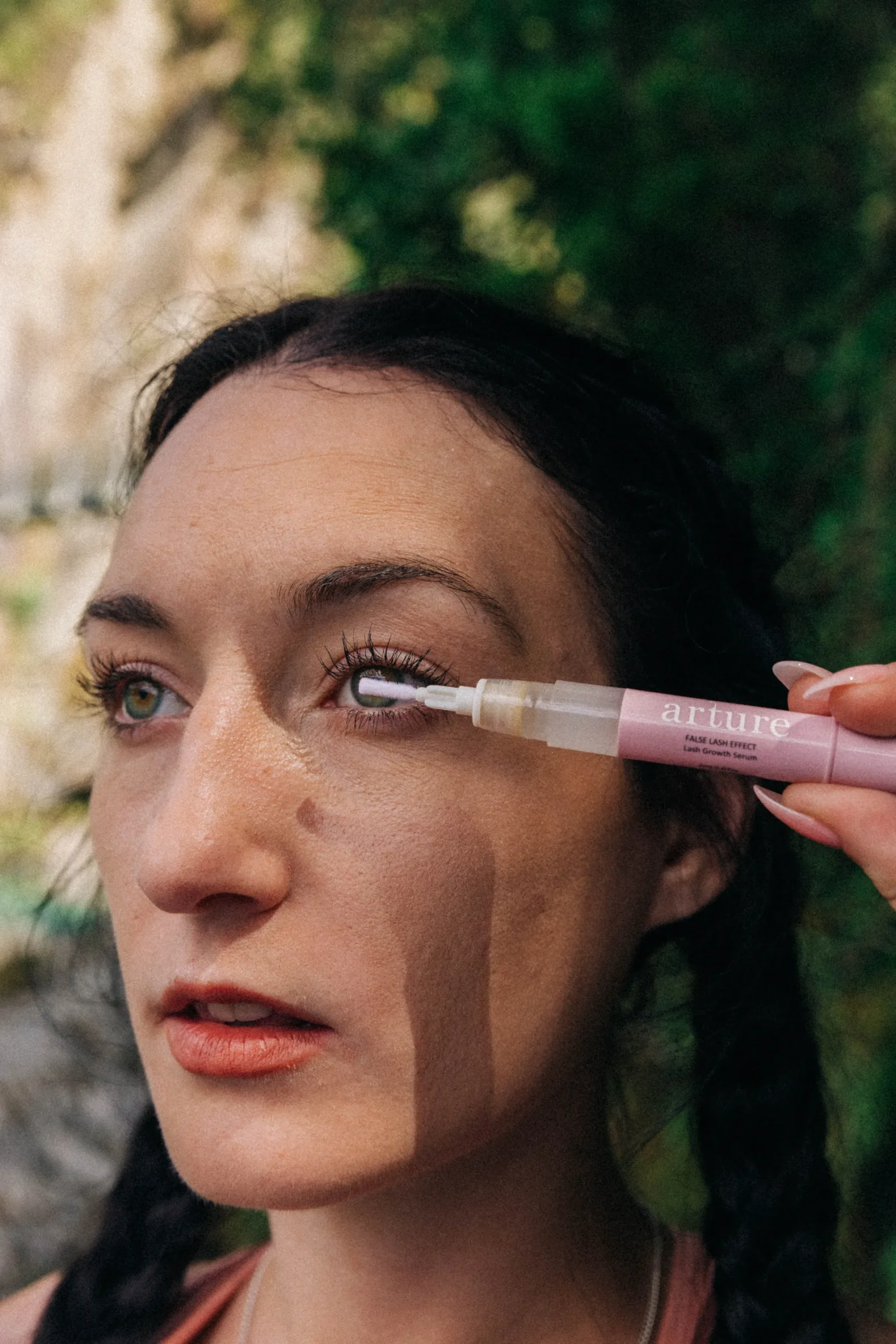
Castor oil for face care shows up nearly everywhere in the marketing: as a cleansing-oil ingredient, a general moisturizer, a spot treatment for dark circles, and, most famously, a home remedy for longer, thicker eyelashes and eyebrows. This site’s oil cleansing method guide already covers castor oil’s general dermatology evidence, its single-arm hyperpigmentation trial, and its documented allergy risk in depth, so this guide doesn’t repeat that ground.
Instead, it focuses on the claim that made castor oil a bathroom-cabinet staple in the first place, that it grows longer lashes and fuller brows, because that claim has never actually been tested, and the biological mechanism people cite for it targets the wrong receptor entirely.
Key Takeaways
- No clinical trial has ever tested castor oil for eyelash or eyebrow growth. The evidence gap isn’t “understudied,” it’s a complete absence of trials on the specific claim.
- The mechanism people cite, ricinoleic acid triggering a prostaglandin response, is real, but it activates the EP3 receptor in intestinal and uterine smooth muscle, the reason castor oil works as a laxative. Eyelash follicle growth runs through a completely different receptor, FP, which is what bimatoprost (Latisse) actually targets.
- Bimatoprost has real trial evidence behind it: a 278-person, 16-week randomized trial found 78.1% of treated subjects had a meaningful improvement in lash growth, versus 18.4% on vehicle, with length up 25% and thickness up 106%. Nothing comparable exists for castor oil.
- What castor oil likely does on lashes is cosmetic, not biological: coating the hair shaft as an occlusive emollient, reducing breakage, and making existing lashes look fuller and glossier.
- Castor oil does have real randomized trial evidence for a different eye-area use entirely: treating blepharitis and dry eye, not growing lashes.
Table of Contents
The Eyelash Growth Claim: Zero Clinical Trials
Search “castor oil eyelashes” and you’ll find an enormous volume of anecdotal enthusiasm and almost no actual research. That’s not an exaggeration for effect: no randomized controlled trial, and no peer-reviewed human study of any design, has tested castor oil’s effect on eyelash length, thickness, or density. The same is true for eyebrows.
There’s no study showing it reactivates dormant follicles, extends the growth phase of the hair cycle, or increases hair count at the brow or lash line. This is a genuinely different situation from an ingredient with weak or mixed evidence; it’s an ingredient with a specific, famous claim and no trial ever run on it.
Why the Proposed Mechanism Doesn’t Actually Support the Claim
The biological argument for castor oil and lash growth usually goes: castor oil contains ricinoleic acid, ricinoleic acid activates prostaglandin signaling, and prostaglandins grow eyelashes, therefore castor oil grows eyelashes. Each individual piece of that chain has some truth to it, but they don’t connect the way the argument implies.
Tunaru and colleagues, publishing in the Proceedings of the National Academy of Sciences in 2012, identified exactly which prostaglandin receptor ricinoleic acid activates: EP3, a receptor found on smooth muscle cells in the intestine and uterus. That’s the actual, confirmed mechanism behind castor oil’s well-known laxative effect, demonstrated using mice genetically engineered to lack the EP3 receptor, which lost the laxative response entirely. Whether a castor oil pack on the abdomen does anything similar is a separate question, covered in our castor oil pack guide.
Eyelash growth, by contrast, runs through a different prostaglandin receptor altogether: FP, expressed in the dermal papilla of hair follicles, where its activation prolongs the anagen (active growth) phase of the hair cycle. This is the receptor bimatoprost, the active ingredient in the FDA-approved lash treatment Latisse, was specifically designed to target.
Ricinoleic acid activating EP3 in your gut is real pharmacology. It has no established path to activating FP receptors in a hair follicle’s dermal papilla. The mechanism people invoke to explain castor oil’s lash effect is a real mechanism, for a completely different tissue and a different receptor than the one that actually governs lash growth.
What a Real Trial Looks Like: Bimatoprost’s Evidence
It’s worth seeing what actual eyelash-growth evidence looks like, if only to show the size of the gap. Smith, Fagien, Whitcup, and colleagues, publishing in the Journal of the American Academy of Dermatology in 2012, ran a multicenter, randomized, double-masked, vehicle-controlled trial in 278 people, comparing topical bimatoprost 0.03% against an inactive vehicle over 16 weeks. At week 16, 78.1% of the bimatoprost group showed at least a one-grade improvement on a standardized eyelash assessment scale, compared to 18.4% on vehicle. Lash length increased by roughly 25%, thickness by around 106%, and darkness by about 18%, all statistically significant improvements over vehicle.
That’s what a genuine efficacy claim looks like: a specific, adequately powered trial, a real comparator, and quantified results. Nothing comparable exists for castor oil on lashes or brows, at any concentration or application frequency.

What Castor Oil Probably Does on Lashes and Brows
None of this means castor oil does nothing when you apply it to your lash line. It’s a thick, occlusive oil, and applied to the hair shaft, it plausibly coats existing lashes and brow hairs, reduces moisture loss, and lowers mechanical breakage from rubbing, brushing, or removing makeup. That can make existing lashes look fuller, glossier, and less brittle, a real, visible, cosmetic effect. It’s just a different claim than “grows new lashes,” and the two get conflated constantly in how castor oil for face and lash use is marketed and discussed.
The One Real Eye-Area Win: Blepharitis, Not Growth
Castor oil does have genuine randomized controlled trial evidence for an eye-area condition, just not the one it’s usually marketed for. Sandford, Muntz, and Craig, publishing in Clinical and Experimental Optometry in 2021, ran a trial applying 100% cold-pressed castor oil to the eyelids of 26 patients with blepharitis (eyelid margin inflammation) twice daily for four weeks. The treatment produced a statistically significant reduction in dry-eye symptom scores (p = 0.001), with no adverse events reported.
That’s a legitimate, specific, positive result, for managing an inflammatory eyelid condition, not for stimulating new lash growth. It’s worth knowing this result exists, since it’s easy to see a positive castor-oil-and-eyelids headline and assume it’s about growth when it’s actually about a completely different problem.
Castor Oil on Lips and General Facial Skin
Castor oil for face and lip use relies on the same high ricinoleic acid content, which gives it real emollient, film-forming properties, the same basic occlusive mechanism this site’s complete guide to body oil covers for skin generally, and that mechanism plausibly extends to chapped lips as a barrier against moisture loss.
No dedicated clinical trial has tested castor oil on lips specifically, though, so this is a reasonable mechanism-based use rather than a directly proven one. For castor oil’s broader facial skin evidence, including its anti-inflammatory and antioxidant research, its single-arm trial for under-eye hyperpigmentation, and its documented allergy risk, see our oil cleansing method guide, which covers that ground in full.
Safety Notes Specific to the Eye Area
Using castor oil for face care near the eyes carries risks beyond the general allergy potential already covered elsewhere on this site. Getting oil directly into the eye can cause temporary blurred vision, and inhaling aspirated oil droplets, while rare, has been linked to lipoid pneumonia in case reports involving oils used near the nose and mouth. Apply castor oil to the lash line with a clean spoolie or cotton swab rather than a dropper aimed at the eye itself, and patch-test on your inner arm first given castor oil’s documented, if uncommon, contact-allergy potential.
Castor Oil for Face: How to Use It Realistically
- Don’t expect eyelash or eyebrow growth. No trial supports that specific claim, and the mechanism usually cited for it targets the wrong biological pathway.
- Use it for conditioning, not growth, on lashes and brows if you want a glossier, less brittle look, applied sparingly with a spoolie.
- Consider it for eyelid margin irritation if that’s your actual concern; the blepharitis trial above is castor oil’s strongest eye-area evidence.
- Patch-test before facial use, and keep it away from direct eye contact.
- For more on castor oil for face and cleansing use, see this site’s other castor oil coverage rather than treating this guide as the full picture.
Frequently Asked Questions
Does castor oil actually grow eyelashes?
No clinical trial has tested this claim. The proposed mechanism, ricinoleic acid triggering prostaglandin activity, is real, but it activates a different receptor (EP3, the laxative pathway) than the one that governs eyelash growth (FP, the pathway bimatoprost/Latisse targets).
What does castor oil actually do for eyelashes, if not grow them?
It likely works as an occlusive coating: sealing moisture into the hair shaft, reducing breakage, and making existing lashes look fuller and glossier. That’s a real cosmetic effect, distinct from stimulating new growth.
Is there any real eye-area evidence for castor oil?
Yes, but not for growth. A 2021 randomized trial found castor oil applied to the eyelids significantly improved symptoms of blepharitis and dry eye, a different condition from lash growth entirely.
Is castor oil for face use safe near the eyes?
Generally, with care. Avoid direct eye contact, which can cause temporary blurred vision, apply with a spoolie or cotton swab rather than a dropper, and patch-test first given castor oil’s documented, if uncommon, contact-allergy risk.
The Bottom Line on Castor Oil for Face
Castor oil’s single most famous facial claim, that it grows longer, thicker lashes and brows, has no clinical trial behind it, and the biological mechanism usually cited to explain it activates the wrong prostaglandin receptor for the job. Bimatoprost’s real trial evidence shows what an actual eyelash-growth treatment’s data looks like, and it’s not close to what exists for castor oil.
What castor oil likely does deliver on lashes is a genuine but more modest cosmetic effect: coating, conditioning, and reduced breakage, plus a separate, real, randomized-trial-backed benefit for eyelid inflammation that has nothing to do with growth. None of that makes castor oil for face use worthless. It means the specific claim that made it famous isn’t the claim the evidence actually supports.
About the Author
Priya Nandan, Licensed Cosmetologist, specializes in textured and chemically treated hair care. Read our editorial policy for how we research, source, and fact-check haircare content.
Sources
- Tunaru, S., Althoff, T.F., Nüsing, R.M., Diener, M., & Offermanns, S. “Castor Oil Induces Laxation and Uterus Contraction via Ricinoleic Acid Activating Prostaglandin EP3 Receptors.” Proceedings of the National Academy of Sciences, 109(23), pp. 9179-9184, 2012. pnas.org/doi/10.1073/pnas.1201627109
- Smith, S., Fagien, S., Whitcup, S.M., et al. “Eyelash Growth in Subjects Treated With Bimatoprost: A Multicenter, Randomized, Double-Masked, Vehicle-Controlled, Parallel-Group Study.” Journal of the American Academy of Dermatology, 66(5), pp. 801-806, 2012. pubmed.ncbi.nlm.nih.gov/21899919
- Sandford, E.C., Muntz, A., & Craig, J.P. “Therapeutic Potential of Castor Oil in Managing Blepharitis, Meibomian Gland Dysfunction and Dry Eye.” Clinical and Experimental Optometry, 104(3), pp. 315-322, 2021. pubmed.ncbi.nlm.nih.gov/33037703
- Prostaglandin F2α (FP) receptor expression and function in human hair follicle dermal papilla; general hair-follicle prostanoid-signaling literature, distinguishing the FP-receptor growth pathway from castor oil’s confirmed EP3 target.
- Castor oil’s general dermatology evidence, hyperpigmentation trial, and allergic contact dermatitis case reports are covered in full in our oil cleansing method guide.