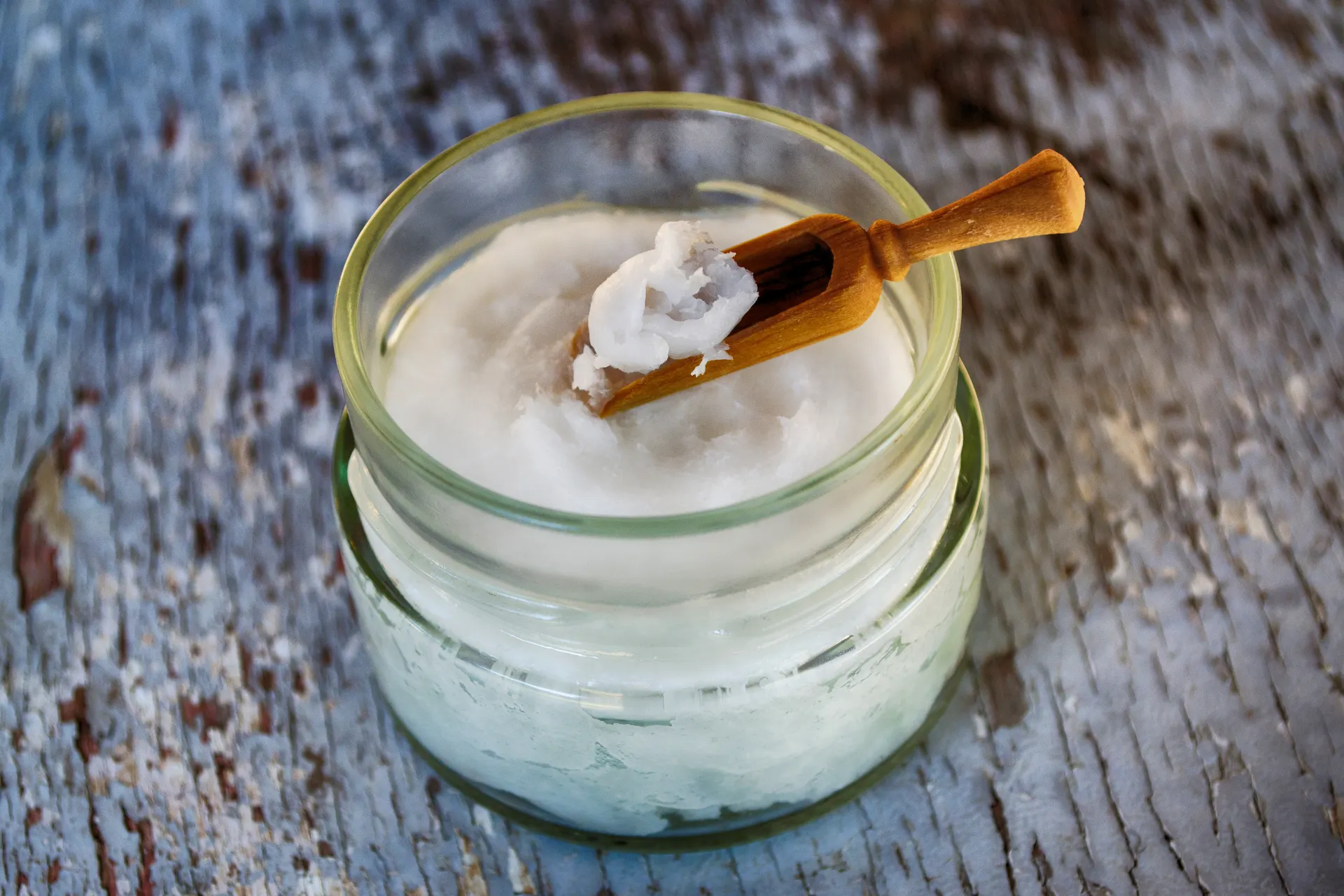
Coconut oil for massage is probably the single most recognizable option there is, cheap, widely available, and pleasant-smelling without any added fragrance. It’s also, depending on which form you buy, either a solid that melts on contact with warm skin or a thin liquid that behaves nothing like it, and it carries a genuinely good piece of clinical evidence for skin barrier repair sitting right alongside one of the higher comedogenic ratings of any commonly used oil.
This guide covers both sides plainly, since “coconut oil is great for skin” and “coconut oil is one of the more pore-clogging oils” are both true statements about the same ingredient.
Key Takeaways
- Coconut oil for massage is really two different products: whole (virgin or refined) coconut oil, which is solid below about 76°F and melts on contact with warm skin, and fractionated (MCT) coconut oil, which has the longer-chain fatty acids removed and stays liquid at any temperature.
- A 117-patient randomized trial found topical virgin coconut oil outperformed mineral oil for skin barrier repair in pediatric eczema, with a larger drop in transepidermal water loss and a bigger improvement in the eczema severity score over 8 weeks.
- Coconut oil’s lauric acid content breaks down into monolaurin, a compound with documented antibacterial activity against Staphylococcus aureus in lab testing, though that’s an isolated-compound, in-vitro result, not proof that rubbing coconut oil on skin delivers the same effect.
- Coconut oil is also widely rated among the more comedogenic common oils, a real tradeoff worth knowing before using it on acne-prone skin, including the back and chest, both common massage areas.
- Fractionated coconut oil is generally the more practical choice for professional massage specifically, since it doesn’t need to melt first, absorbs faster, and doesn’t stain sheets the way the whole oil can.
Table of Contents
Two Different Products Wearing the Same Name
Whole coconut oil, whether virgin (cold-pressed, unrefined) or refined, is solid at typical room temperature, with a melting point around 24°C (76°F), well below body temperature. That’s why a jar of coconut oil can go from solid to liquid the moment it touches warm skin, a genuinely distinctive sensory property for a massage oil: you start with a solid scoop and it melts into the massage itself.
Fractionated coconut oil, often sold as MCT oil for topical use, is produced by removing coconut oil’s longer-chain fatty acids, leaving mostly the medium-chain caprylic and capric acids behind.
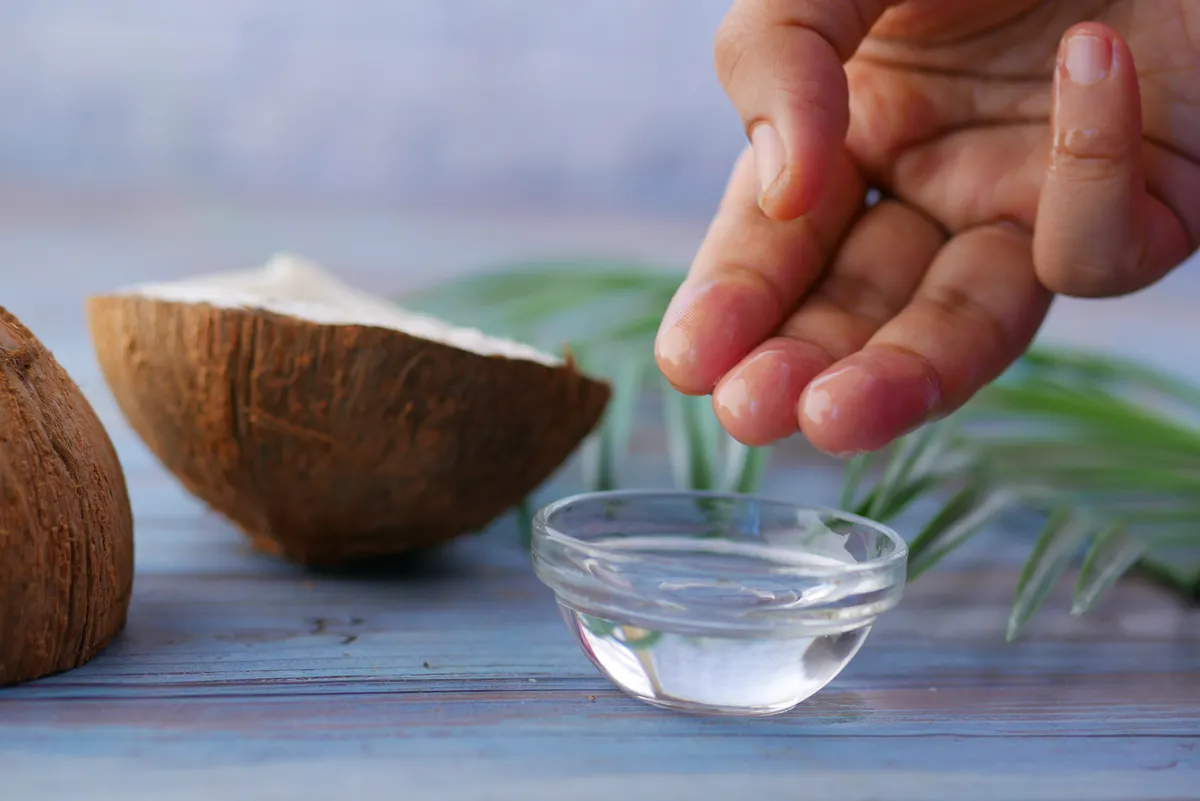
The result stays liquid at any normal temperature, including refrigeration, and behaves like a much thinner oil than the whole version, lighter and faster to spread, while still providing enough glide to last through a full session, which is why our massage oil guide lists it alongside grapeseed oil as a common choice for lighter, longer-stroke work. It’s the form most professional massage suppliers specifically recommend, since it doesn’t require pre-melting and rinses out of sheets and towels more easily than the whole oil.
The Real Evidence: Coconut Oil and Skin Barrier Repair
Evangelista, Abad-Casintahan, and Lopez-Villafuerte, publishing in the International Journal of Dermatology in 2014, ran a randomized, double-blind trial comparing topical virgin coconut oil against mineral oil in 117 children with mild to moderate atopic dermatitis (eczema), over 8 weeks. The coconut oil group’s eczema severity score (SCORAD) dropped by 68.23% from baseline, compared to 38.13% in the mineral oil group (P < .001).
Transepidermal water loss, a direct measure of how much water the skin barrier is losing, fell from 26.68 to 7.09 in the coconut oil group, versus 24.12 to 13.55 in the mineral oil group, and skin capacitance, a hydration measure, improved more in the coconut oil group as well.
That’s a real, well-designed, positive result, and it’s specific to eczema-prone pediatric skin compared against a specific comparator, mineral oil. It’s a genuinely good data point for coconut oil’s occlusive, barrier-supporting properties, the same basic mechanism this site’s massage oil guide and hair growth oils guide reference for other oils, applied here to a population where barrier repair specifically was the outcome being measured. Our Vaseline ingredient breakdown covers two more coconut-oil-versus-mineral-oil trials, this time for general dry skin (xerosis) rather than eczema specifically.
The Antimicrobial Angle: Real Mechanism, Lab-Dish Evidence
Coconut oil is roughly 45-52% lauric acid, which breaks down into monolaurin, a compound with documented antibacterial activity. Carpo, Verallo-Rowell, and Kabara, publishing in the Journal of Drugs in Dermatology in 2007, tested monolaurin’s in-vitro sensitivity against bacteria commonly isolated from skin infections, including Staphylococcus aureus, and found strong antibacterial activity comparable in some respects to conventional antibiotics tested in the same lab conditions.
That’s a real, mechanistically specific finding, monolaurin genuinely disrupts the cell membranes of certain gram-positive bacteria, but it’s an isolated-compound result generated in a lab dish, not a measurement of what happens when whole coconut oil, at the concentration and purity found in a bottle, is massaged onto human skin. Treat it as a plausible mechanism worth knowing about, not a tested clinical outcome for topical coconut oil use.
The Comedogenic Tradeoff of Coconut Oil for Massage
The same properties that make coconut oil feel rich and occlusive on skin are part of why it’s widely rated among the more pore-clogging common oils, roughly a 4 out of 5 on the widely cited comedogenicity scale, covered in full detail, including that scale’s real limitations, in our natural hair oil guide.
For a full-body massage, that’s a real, practical consideration specifically for the back and chest, two areas massage regularly covers and two of the more common sites for body acne. It doesn’t mean coconut oil causes breakouts for everyone, individual response varies considerably, but it’s a reasonable factor to weigh before using coconut oil for massage if you or a client is prone to body acne in the areas being massaged.
How to Choose Between Whole and Fractionated Coconut Oil for Massage
- Choose fractionated (MCT) coconut oil for most professional or repeated massage use. It doesn’t need to melt first, absorbs at a moderate, workable pace, and is less likely to stain sheets than the whole oil.
- Choose whole coconut oil if the melting sensation itself is part of the experience you want, or for occasional, at-home use where sheet staining isn’t a concern.
- Patch-test on acne-prone skin first, particularly on the back or chest, given coconut oil’s comedogenic rating.
- Consider it seriously for dry, barrier-compromised skin specifically, where the clinical evidence is genuinely strongest, rather than treating it as a universal, no-tradeoff default.
Frequently Asked Questions
Is coconut oil actually good for your skin?
The evidence is genuinely mixed by context. A randomized trial found virgin coconut oil outperformed mineral oil for skin barrier repair in eczema-prone skin. Separately, coconut oil is widely rated among the more comedogenic common oils, a real consideration for acne-prone skin.
What’s the difference between coconut oil and fractionated coconut oil for massage?
Whole coconut oil is solid at room temperature and melts on contact with warm skin. Fractionated (MCT) coconut oil has the longer-chain fatty acids removed, stays liquid at any temperature, and is generally easier to work with for repeated massage use.
Does coconut oil actually kill bacteria on skin?
Its lauric acid breaks down into monolaurin, which has documented antibacterial activity against bacteria like Staphylococcus aureus in lab testing. That’s real mechanistic evidence, but it comes from isolated-compound lab studies, not a trial of coconut oil applied topically for that specific purpose.
Will coconut oil clog my pores if I use it as a massage oil?
It’s a real possibility to consider if you’re using coconut oil for massage. Coconut oil is widely rated around 4 out of 5 on the comedogenicity scale, higher than many other common carrier oils, which matters most for acne-prone skin on areas like the back and chest.
The Bottom Line on Coconut Oil for Massage
Coconut oil earns both sides of its reputation. A well-designed randomized trial found virgin coconut oil genuinely outperformed mineral oil for skin barrier repair in eczema-prone skin, and its lauric acid content has a real, documented antibacterial mechanism, even if that specific evidence comes from lab-dish testing rather than a topical-use trial. At the same time, it’s widely rated among the more pore-clogging common oils, a real tradeoff for acne-prone skin on the areas massage most often covers.
And “coconut oil” itself isn’t one product: whole coconut oil melts on skin contact, while fractionated coconut oil stays liquid and is generally the more practical choice for regular massage work. None of that makes coconut oil for massage a bad choice. It means picking the right form for the job, and being honest that the ingredient with real barrier-repair evidence is the same one carrying a real comedogenic tradeoff.
About the Author
Priya Nandan, Licensed Cosmetologist, specializes in textured and chemically treated hair care. [PLACEHOLDER: replace with your site’s actual credentialed author, bio, and author-page link before publishing.] Read our editorial policy for how we research, source, and fact-check haircare content.
Sources
- Evangelista, M.T.P., Abad-Casintahan, F., & Lopez-Villafuerte, L. “The Effect of Topical Virgin Coconut Oil on SCORAD Index, Transepidermal Water Loss, and Skin Capacitance in Mild to Moderate Pediatric Atopic Dermatitis: A Randomized, Double-Blind, Clinical Trial.” International Journal of Dermatology, 53(1), pp. 100-108, 2014. onlinelibrary.wiley.com/doi/10.1111/ijd.12339
- Carpo, B.G., Verallo-Rowell, V.M., & Kabara, J. “Novel Antibacterial Activity of Monolaurin Compared With Conventional Antibiotics Against Organisms From Skin Infections: An In Vitro Study.” Journal of Drugs in Dermatology, 6(10), pp. 991-998, 2007. pubmed.ncbi.nlm.nih.gov/17966176
- General food-science and cosmetic-chemistry references on coconut oil’s melting point (approximately 24°C/76°F) and fractionated (MCT) coconut oil composition; general compositional references rather than a single primary trial.
- Coconut oil’s comedogenicity rating and the underlying scale’s limitations are covered in full in our natural hair oil guide.